
Research Highlight
Drugging the Undruggable: Designing T417, a Small Molecule That Blocks PBX1
Transcription factors have long been considered impossible to target with drugs. By designing a molecule that wedges into the gap between PBX1 and the DNA it reads, we made platinum-resistant ovarian tumors sensitive to chemotherapy again.
Published
The problem: tumors that come back resistant
Surgery and chemotherapy have extended survival for people with advanced cancer, but long-term remission is still rare, because most tumors eventually stop responding to the drugs that first worked. Ovarian high-grade serous carcinoma is a stark example. It remains one of the most lethal cancers of the female reproductive tract, and the reason is recurrence after intensive chemotherapy.
What makes this disease puzzling is that genome-wide sequencing has not turned up the usual suspects. Apart from mutations in TP53, there are few recurrent mutations in cancer driver genes. That suggests the problem is not a broken gene sequence but a rewiring of pathways, through changes in DNA copy number or in the epigenome.
Following that logic, our group had earlier mapped copy number changes in ovarian cancer and found amplification of the Notch3 locus. Working out what Notch3 switches on led to PBX1, a transcription factor that turned out to be a downstream target. PBX1 sits at chromosome 1q23.3, a region frequently amplified in cancer, and it is overexpressed in many tumors. In ovarian cancer it helps maintain cancer stem cell-like behavior and resistance to platinum drugs; in ER-positive breast cancer it reprograms cells so they stop responding to anti-estrogen therapy. We have written about what PBX1 does across cancers in a separate article.
The obvious next question was whether a drug could shut PBX1 down. In 2021 we published our answer in iScience: Development of small molecule inhibitors targeting PBX1 transcription signaling as a novel cancer therapeutic strategy. Unlike our two review articles, this one reports original experiments.
Why transcription factors were considered undruggable
Most cancer drugs work by jamming an enzyme. Enzymes have an active site, a deep pocket shaped to hold the molecule they act on, and a drug can be built to sit in that pocket and block it.
Transcription factors do not work that way. They act by touching DNA and other proteins, and those contact surfaces are broad and flat, with few pockets to grip. For that reason transcription factors, PBX1 among them, were classed as undruggable, despite being some of the most important drivers in cancer.
There was, however, a structural detail to exploit. Earlier structural work had shown that PBX1 grips its DNA target sequence, the short motif 5'-TGATT-3', through a conserved hydrophobic pocket. If a small molecule could be designed to sit in that exact spot, it would occupy the place where DNA binds. PBX1 would still be present in the cell, but it could no longer read its targets.
Designing the molecule
We synthesized a series of compounds predicted by computational docking to fit between PBX1 and its DNA binding interface, then tested them in the laboratory. Several assays were used, each asking a different question.
Does the compound pull PBX1 off DNA? In an electrophoretic mobility shift assay, purified PBX1 protein was mixed with labeled DNA containing its binding motif. Three compounds broke up the complex in a dose-dependent way: T417, T418 and T383, with half-maximal inhibition at roughly 5–8 µM.
Does the compound actually bind PBX1 inside cells? A cellular thermal shift assay measures how much a protein resists being destroyed by heat, which increases when a drug is bound to it. At 58 °C, more than half of the PBX1 protein was still held by T417, while the other analogs held less than half. T417 formed the most stable complex of everything tested.
How tightly does PBX1 hold DNA, and can the compound compete? Using surface plasmon resonance, we measured PBX1 binding to its consensus DNA with a dissociation constant of 0.8 nM, more than four orders of magnitude tighter than its binding to a control sequence without the motif. That is a very firm grip to interrupt. Of eight analogs tested, only T417 reduced it, and raising the T417 concentration pushed PBX1 off the DNA progressively, with a half-maximal effect around 5 µM.
Where exactly does it sit? Computational docking against published PBX1 structures produced a best pose in which T417 forms five hydrogen bonds with the protein, contacting residues H205, K266, R288, I289 and K292, with its naphthalene ring packing against the side chain of Ile 289. Those bonds both hold the compound in the DNA binding groove and contribute to its selectivity.
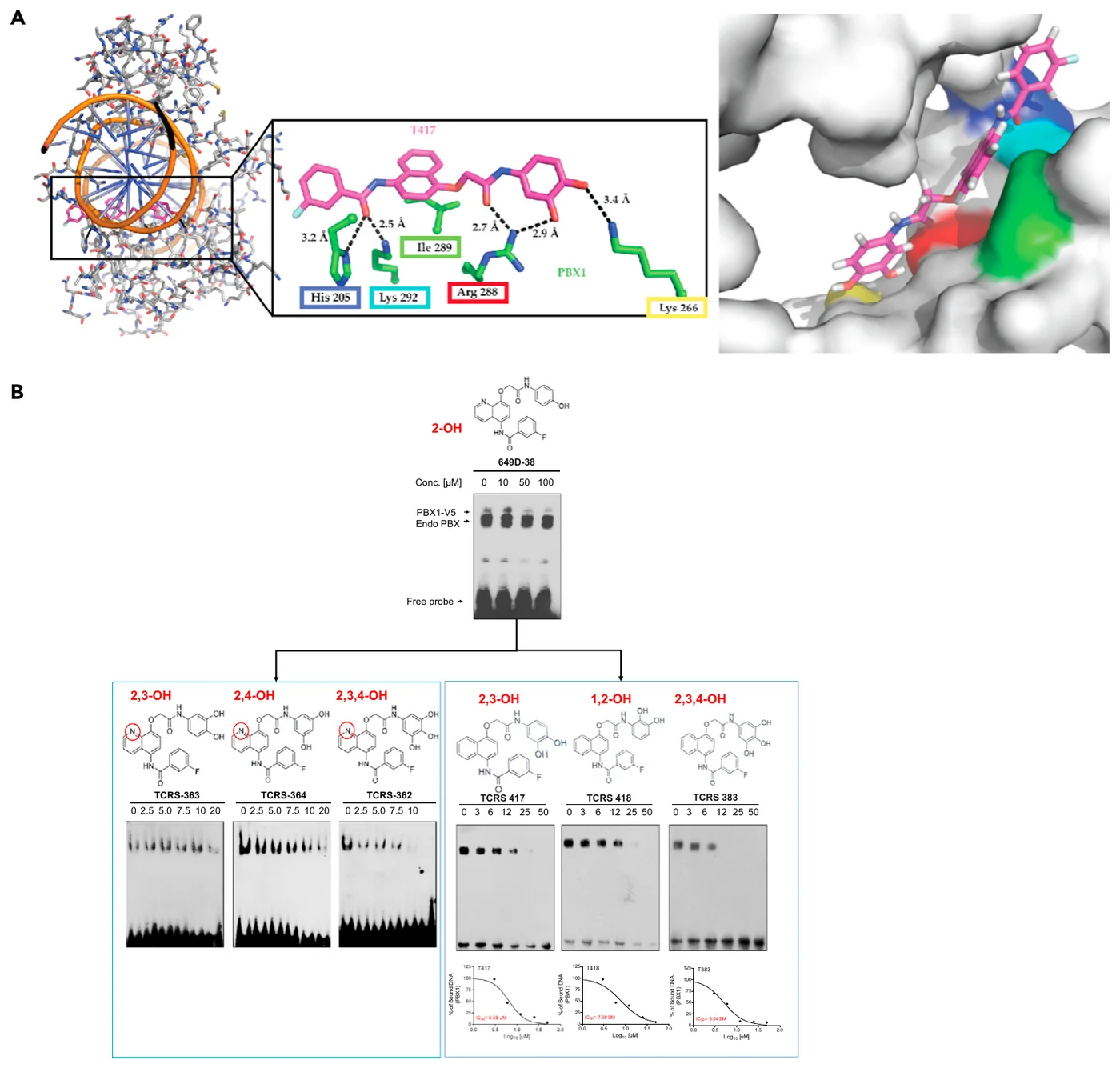
PBX1 rarely acts alone. It pairs with other homeodomain proteins, such as MEIS2, to form complexes that bind DNA with greater specificity. We found that T417 also broke up the PBX1/MEIS2/DNA complex, at a similar potency to the simpler PBX1–DNA complex, so the compound is not evaded by PBX1 switching partners.
Does blocking the binding site actually silence PBX1?
Breaking a protein–DNA contact in a test tube is one thing; silencing a transcription factor inside a living cell is another. Three lines of evidence say it works.
In a reporter assay using the promoter of MEOX1, a known PBX1 target gene, T417 reduced PBX1-driven transcription in a dose-dependent way. Chromatin immunoprecipitation then showed that T417 reduced how much PBX1 protein was actually sitting on its target promoters inside cells, and the target genes' expression fell accordingly.
The broadest test compared gene expression patterns. We first defined the set of genes PBX1 controls by silencing PBX1 with siRNA and seeing what changed. Then we asked whether T417 changed the same genes. It did: the PBX1-regulated gene set was significantly enriched among the genes T417 affected. Gene sets for the stem cell factors NANOG, OCT4, SOX2 and MYC, and an embryonic stem cell signature, were enriched too, which matches the idea that PBX1 supports stem-like behavior.
The level of PBX1 predicts which cells respond
If T417 works through PBX1, then cells with more PBX1 should be more sensitive to it. We measured PBX1 in a panel of 28 cancer cell lines, most from ovarian tumors, and tested their response. PBX1 level and T417 sensitivity correlated (r = 0.555, p < 0.001). The correlation was only marginal for T418, and absent for an inactive control compound, which is what you would expect if the effect is specific. In cells taken directly from patients' ovarian tumors the same pattern held (r = 0.64, p < 0.01).
This matters beyond the laboratory. If PBX1 level predicts response, it could one day be used to choose which patients to treat, a companion biomarker rather than a guess.
Reversing platinum resistance
The clinical question is recurrence. To model it, we grew ovarian cancer lines (OVCAR3 and SKOV3) into carboplatin-resistant and taxol-resistant variants. PBX1 was higher in the carboplatin-resistant cells than in the taxol-resistant or parental cells, and those carboplatin-resistant cells were correspondingly more vulnerable to T417.
Two further results followed. T417 reduced the cells' ability to form tumor spheroids, the three-dimensional cultures that test self-renewal, pushing them back toward a more differentiated state. And when carboplatin-resistant cells were treated with T417 together with carboplatin, they became sensitive to carboplatin again (p = 0.0066 for OVCAR3-CR, p = 0.0108 for SKOV3-CR).
Why would blocking a transcription factor restore platinum sensitivity? Our earlier profiling offers a clue: PBX1 positively regulates the glutathione pathway. Glutathione is the cell's main redox buffer, and high levels of it are a major cause of chemoresistance, because glutathione can bind platinum drugs directly and mop up the reactive oxygen species they generate. Shutting down PBX1 should therefore weaken that defense. The same logic runs through our article on targeting glutamine metabolism in cancer stem cells, since glutamine is what glutathione is made from.
In animals: effective where PBX1 is high, and well tolerated
Before testing efficacy, we tested safety. Mice received T417 three times a week at 5 mg/kg for three weeks. There were no significant differences in blood counts or clinical chemistry compared with vehicle-treated mice, no lethargy or weight loss, and no tissue damage on examination of the brain, heart, lung, liver, spleen, kidney and intestine. This fits the observation that most normal adult tissues carry little PBX1: a drug aimed at PBX1 has little to act on in healthy organs.
In tumor-bearing mice the results tracked PBX1 levels exactly as predicted:
- Parental SKOV3 tumors, which express less PBX1, did not respond to T417, and their PBX1 target genes were unchanged.
- Carboplatin-resistant SKOV3 tumors responded to T417 alone and to T417 with carboplatin, with prolonged remission and reduced growth, and their PBX1 target genes MEOX1 and BCL6 were switched down.
- A2780 tumors, which carry high PBX1, grew significantly more slowly on the combination of T417 and carboplatin than on either alone, and the final tumors weighed less.
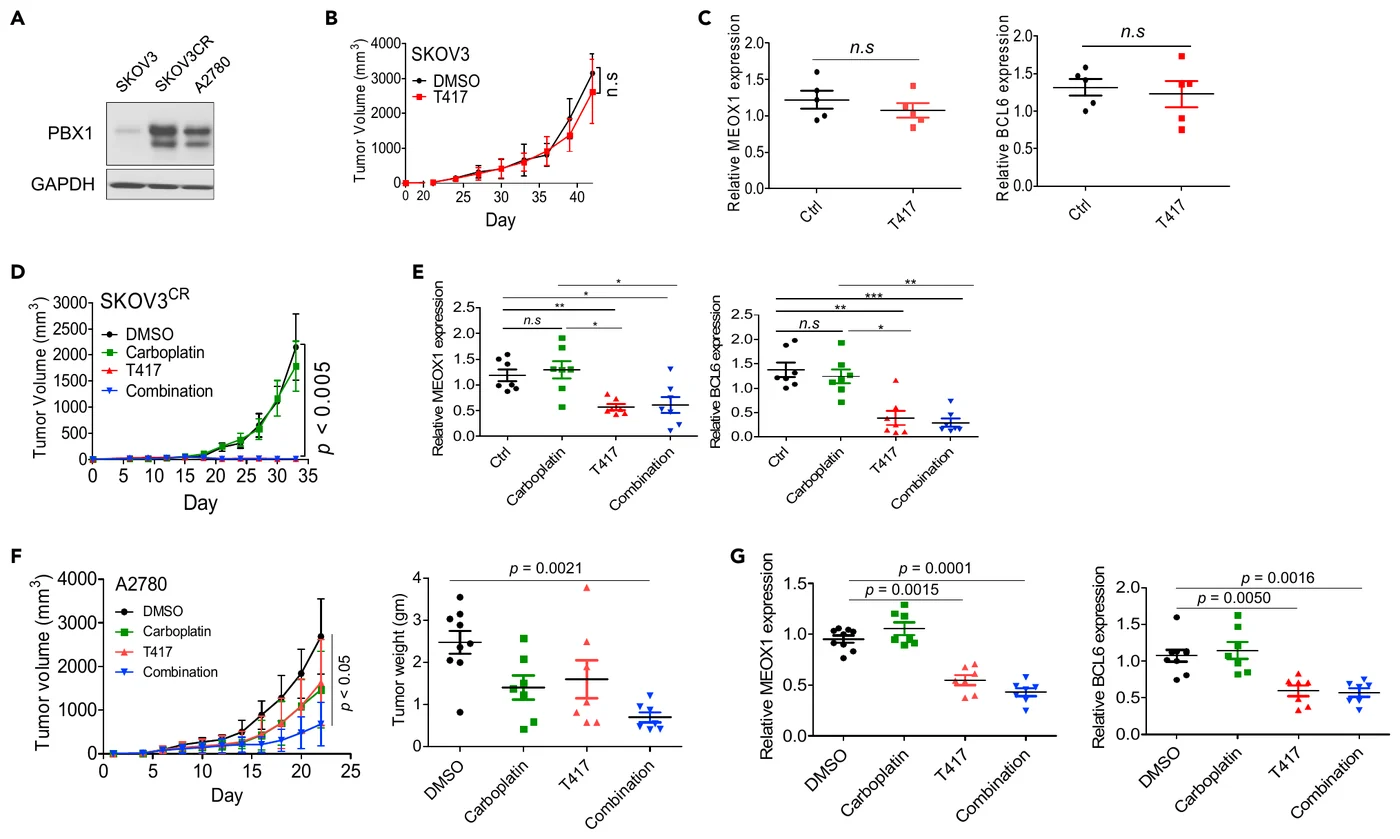
The absence of a response in the low-PBX1 tumors is as informative as the response in the high-PBX1 ones. It shows the compound is doing what it was designed to do rather than being generally toxic.
What this means, and what it does not
To our knowledge, T417 is the first class of compound to inhibit tumor growth by directly interfering with PBX1's transcriptional activity. There is a second reason the approach is attractive. Other attempts to block PBX1 have used peptides, which tend to suffer from instability, poor entry into cells, low oral availability and immune reactions. A small molecule can sidestep those problems.
The study has clear limits, which the paper states. There is no crystal structure of T417 bound to PBX1, so the binding pose rests on computation and on indirect biophysical evidence. The anti-tumor work was done in ovarian models, and other PBX1-dependent cancers, ER-positive breast cancer among them, still need testing. Everything here is in cells and mice. T417 has not been given to a patient, and considerable work on safety, efficacy and chemical optimization stands between these results and a clinical trial.
What the study does establish is that a transcription factor once written off as undruggable can be reached by a well-designed small molecule, and that doing so strikes at the resistant, stem-like cells that make tumors come back. That is the thread running through most of our work.
If you are a prospective student interested in structure-based drug design, cancer stem cells or chemoresistance, or a researcher who would like to collaborate, see our Join us page.
Reference: Shen Y-A, Jung J, Shimberg GD, Hsu F-C, Suryo Rahmanto Y, Gaillard SL, Hong J, Bosch J, Shih I-M, Chuang C-M, Wang T-L. Development of small molecule inhibitors targeting PBX1 transcription signaling as a novel cancer therapeutic strategy. iScience. 2021;24(11):103297. DOI · PubMed · PubMed Central